

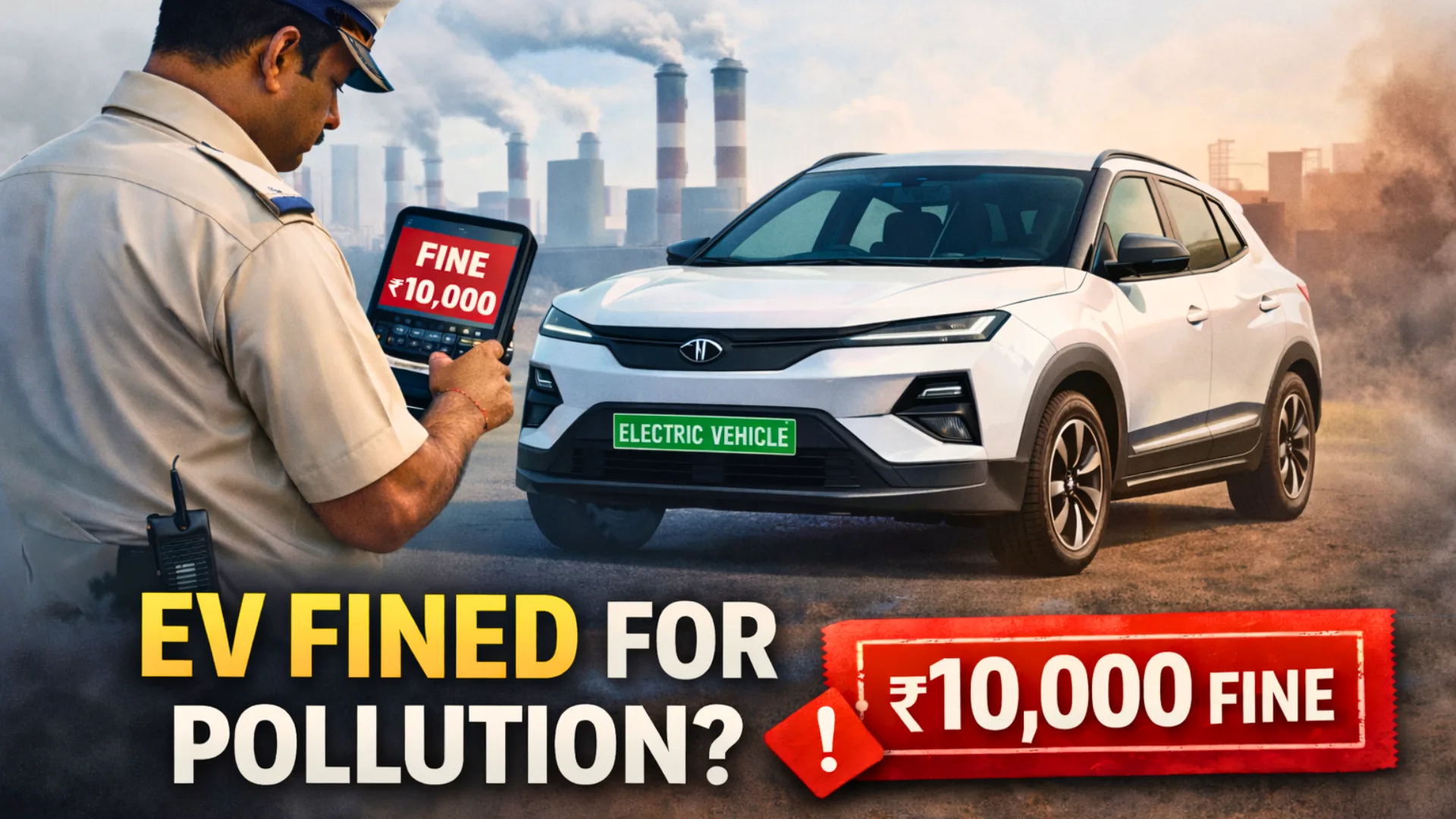
An electric vehicle being fined ₹10,000 for violating air pollution norms in Gurugram has triggered widespread outrage and ridicule online, raising serious concerns about how traffic enforcement systems are adapting to India’s growing EV ecosystem.
The incident came to light after Rattan Dhillon, an off-roader, shared images of the e-challan on X (formerly Twitter). The post quickly went viral, drawing attention to what many described as a glaring enforcement error.
The incident occurred in Gurugram, Haryana, and the e-challan quickly went viral on social media.
The vehicle at the centre of the controversy is reported to be a white Tata Curvv EV, a battery-electric SUV that is legally exempt from the Pollution Under Control (PUC) certificate requirement under Indian motor vehicle rules because it does not emit exhaust gases.
What the Challan Shows
According to images shared online by a user on X (formerly Twitter), the e-challan records two separate penalties:
-
₹2,000 for a driving violation, widely understood to be related to speeding or documentation.
-
₹10,000 for “violating air pollution standards” due to not having a PUC certificate.
The total fine was ₹12,000, though only the latter part ignited public debate. X (formerly Twitter)
Incredible India indeed ₹10,000 fined on an EV vehicle for air pollution violation. How does Haryana Police justify this?
Absolutely shameful! ☺️ https://t.co/9Fy03doev9 pic.twitter.com/08aMX1OwG6— Rattan Dhillon (@ShivrattanDhil1) December 16, 2025
Why is it concerning?
Electric vehicles like the Tata Curvv do not have an internal combustion engine or a tailpipe; they run purely on battery power and produce zero tailpipe emissions.
Under India’s Central Motor Vehicle Rules, EVs are exempt from the PUC certificate requirement, which is meant to measure exhaust pollutants from petrol or diesel vehicles.
The fine for lacking a valid PUC certificate, therefore, appears to be a misapplication of pollution norms rather than a reflection of actual environmental harm.
Possible System or Enforcement Error?
Traffic experts and commentators say what likely happened is a technical or administrative error.
Automated enforcement systems that use cameras and number-plate recognition may not always correctly identify vehicle fuel type from registration data, leading to EVs being treated like conventional vehicles during routine anti-pollution checks.
Such technical mismatches have happened before: there have been other reported instances where two-wheelers or EVs were fined for missing PUC certificates before the system was updated properly.
Public Reaction and Official Response
Social media users reacted with incredulity and humour, questioning how a zero-emission vehicle could be penalised for pollution, with some sarcastically suggesting the fine was for the electricity used to charge the car.
Others expressed concern about enforcement technology not keeping pace with evolving vehicle norms.
In response to the viral post, the Gurugram Traffic Police reportedly asked the vehicle owner to share contact details so they could look into the case, indicating the fine may be reviewed or even invalidated once the context is clarified.
Pollution Enforcement in the Region
The incident comes amid heightened anti-pollution enforcement across the Delhi–NCR region, where authorities have been issuing large numbers of challans for emissions compliance and related violations in recent months.
Under the Graded Response Action Plan (GRAP) and related measures, vehicles without valid Pollution Under Control Certificates have been fined up to ₹10,000 in neighbouring Delhi and surrounding districts.
India’s push toward electric mobility depends not just on incentives and infrastructure, but also on regulatory clarity and enforcement competence. Penalising zero-emission vehicles for pollution violations undermines public confidence and risks discouraging early adopters.
As one user aptly summed it up online: “EV technology is in the 21st century. Enforcement software is not.”
For now, the Gurugram EV challan serves as a viral reminder that while India is racing toward a cleaner mobility future, its systems still need to catch up.
FAQs
1. Can an electric vehicle legally be fined for not having a PUC certificate?
No. Electric vehicles are exempt from Pollution Under Control (PUC) certification under Indian motor vehicle rules because they do not produce tailpipe emissions. Any pollution-related challan issued to a fully electric vehicle is usually a system or enforcement error.
2. Why was an EV fined for pollution in Gurugram despite this exemption?
Such cases typically happen due to automated challan systems or manual entries failing to recognise the vehicle as electric. Outdated databases, incorrect fuel-type tagging, or software logic designed for petrol/diesel vehicles can lead to EVs being wrongly penalised.
3. What should an EV owner do if they receive a pollution challan by mistake?
The owner should contest the challan by submitting vehicle registration details showing it is electric, either online or at the traffic police office. In many cases, authorities review and withdraw such fines once the error is verified.