

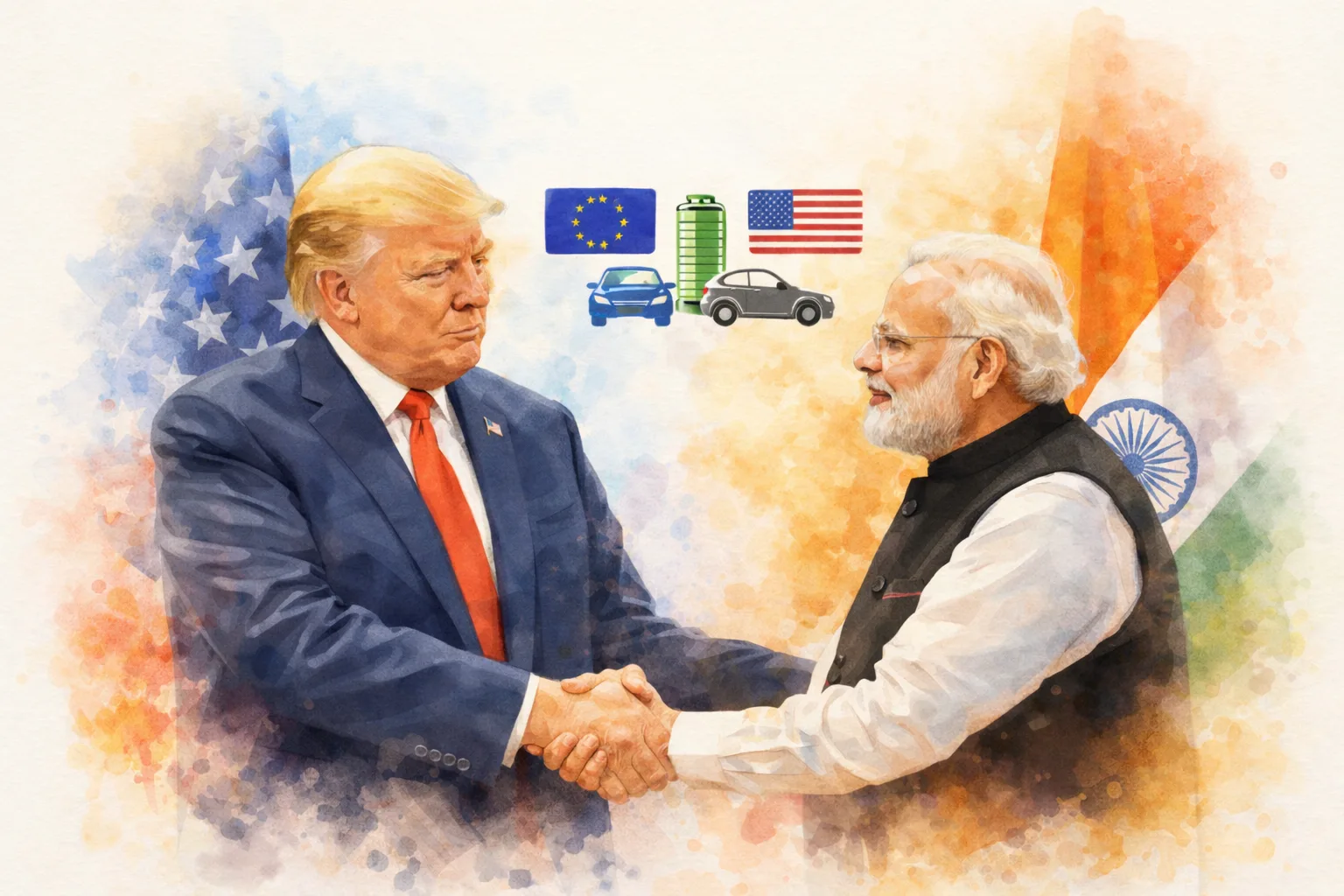
India recently secured two major trade agreements, one with the European Union (concluded January 27, 2026) and another with the United States (announced February 3, 2026). But when it comes to electric vehicles and battery technology, there’s a clear winner.
The Verdict: EU Deal Dominates
The India-EU Free Trade Agreement is significantly superior for India’s EV and battery industry. The India-US deal, while beneficial for overall trade, contains no specific EV or battery provisions and focuses primarily on fossil fuel imports.
Key Numbers at a Glance
| Metric | India-EU Deal | India-US Deal |
| EV Import Quota (after 5 years) | 90,000 vehicles/year | Not specified |
| Protection Period for Domestic EVs | 5 years | None |
| Indian EV Export Quota to Market | 625,000 vehicles to the EU | Not specified |
| Battery Technology Provisions | Battery passports, component investment incentives | None announced |
| Final EV Tariff | Gradual reduction to 10% | General tariff: 50% to 18% |
What This Means for India’s EV Industry
-
Strategic Protection Phase
The EU deal gives Indian EV manufacturers like Tata Motors and Mahindra & Mahindra a 5-year buffer to scale up before facing European competition. This protection period is absent in the US deal.
-
Massive Export Opportunity
Indian manufacturers can export up to 625,000 vehicles to the EU market with reduced tariffs. For context, battery electric vehicles accounted for 10.7% of India’s luxury segment between January and November 2025, and this deal opens a pathway to European markets.
-
Battery Ecosystem Development
The EU deal promotes battery passport standards—digital records of a battery’s lifecycle—which will push Indian manufacturers to upgrade their capabilities. The agreement also creates investment opportunities in EV batteries, power electronics, and wiring systems.
-
Component Manufacturing Boost
India exported automotive components worth $22.9 billion in the previous financial year, with Europe absorbing 29% of these exports. The EU deal strengthens this supply chain relationship.
What Could Change This Outcome? next 3-5 years
While the India–EU agreement currently offers the strongest framework for EV and battery development, this advantage is not permanently locked in. The balance could shift over the next 3–5 years, depending on how India and the US evolve their trade relationship.
A major turning point would be the inclusion of EV and battery materials under the US Inflation Reduction Act (IRA). If India manages to negotiate eligibility for Indian battery components or critical minerals within the IRA framework, Indian manufacturers could gain access to the $7,500 EV subsidy in the US market.
This would instantly make the US a far more attractive destination than the EU in pure volume terms.
Another variable is India’s parallel negotiations with mineral-rich countries such as Australia, Chile, and African nations. Securing long-term lithium, cobalt, and nickel supply agreements could reduce dependence on both EU and US markets and strengthen India’s position as a global battery manufacturing hub.
Finally, tightening climate regulations in Europe, including carbon border taxes and sustainability reporting, could raise compliance costs for Indian exporters and slightly dilute the current advantage of the EU deal.
Risks and Constraints in the EU Deal
Despite its clear benefits, the India–EU agreement is not without challenges for Indian EV manufacturers.
The battery passport system, while technologically progressive, introduces new compliance requirements related to lifecycle data tracking, recycling obligations, carbon footprint disclosures, and ESG audits. These systems will require significant digital infrastructure and operational upgrades, particularly for mid-sized and smaller Indian OEMs.
European sustainability standards are also expected to become stricter over time, especially in areas such as ethical sourcing of minerals, battery recyclability, and supply chain transparency. Failure to meet these benchmarks could limit market access or lead to regulatory penalties.
Additionally, the gradual reduction in tariffs means that Indian companies must use the five-year protection window effectively. If domestic manufacturers fail to achieve scale, cost efficiency, and technology parity within this period, they risk being outcompeted by established European EV brands once full market access opens.
The US Deal Gap
The India-US trade framework announced on February 3, 2026, focuses on reducing general tariffs from 50% to 18% but lacks any EV-specific provisions. The deal emphasises:
- India is stopping Russian oil purchases
- Increasing US energy imports (coal, petroleum)
- General tariff reductions
- Agricultural market access
Indian battery material manufacturers are pushing the government to negotiate a Critical Raw Materials Act with the US to ensure battery materials qualify under the US Inflation Reduction Act’s $7,500 EV subsidy.
However, this is an industry request, not part of the current deal.
Bottom Line
For India’s EV ambitions, the EU deal is transformative while the US deal is a missed opportunity. The EU agreement provides:
Clear market access with 625,000 vehicle export quota, Protection for domestic industry during growth phase, Technology standards that elevate capabilities, Battery and component investment framework, Structured timeline with predictable outcomes.
The US deal, despite covering a $212.3 billion bilateral trade relationship, offers no specific support for India’s electric vehicle transition and ironically focuses on increasing fossil fuel imports rather than clean energy technology.
Sources: EU Commission statements, Indian Ministry of Commerce data, automotive industry reports (January-February 2026)